Walking Meditation: How to Practice Mindfulness While You Move
Have you ever considered how the simple act of moving can become a mindful practice? Walking meditation offers a unique way to turn everyday activities into moments of awareness. Whether you’re in a busy city, a quiet hallway, or a serene park, each step can help you reconnect with your body and surroundings.
This practice invites you to pay attention to your feet touching the ground, the rhythm of your breath, and the sensations around you. By focusing on these elements, you can break free from the autopilot mode that often governs our daily lives. Instead of rushing from one place to another, you can experience each moment fully.
As you explore this method, remember that the goal isn’t to achieve perfection but to gently guide your mind back to the present. You’ll learn to navigate your environment with awareness, keeping an eye out for obstacles and changes in your surroundings.
Key Takeaways
- Transform ordinary movement into a mindful experience.
- Notice your body and surroundings while moving.
- Focus on foot sensations and breathing.
- Practice returning to the present moment.
- Stay aware of your environment for safety.
What is Walking Meditation?
Imagine transforming your daily walks into a journey of mindful experience. Walking meditation is all about being intentionally aware of each step you take. Unlike traditional meditation, which often involves sitting still, this practice invites you to engage your body while moving.
In seated meditation, you focus on your breath or a mantra. In walking meditation, your attention shifts to the lifting, moving, and placing of your feet. This shift allows you to anchor your mind and body in the present moment.
You can practice formally by setting aside time to walk mindfully, or informally while navigating through your day. For example, take a moment to be aware of your steps as you move between floors in a building or while shopping at the supermarket.
When your thoughts become scattered, returning to the sensations in your body can help ground you. You might find comfort in placing your hands at your sides, behind your back, or on your belly, all while maintaining a natural posture.
The Roots and Philosophy of Mindful Walking
What if each step you take could enhance your awareness of the present moment? Mindful walking is deeply rooted in various cultural and historical contexts. This practice connects the body and mind, creating a harmonious experience. The work of Kabat-Zinn and Hanh in *Full Catastrophe Living* (2009) emphasizes this unity, suggesting that every step can be grounding and nourishing.
Mindfulness has diverse expressions across cultures. Research by Hoffman in Haiti (2019) and studies involving Vietnamese youth and First Nations Australians highlight how this practice adapts to different communities. These insights show that mindful walking is not limited to one tradition but is enriched by various perspectives.
Consider how reverence for the earth can deepen your gratitude. This is one way to connect with your surroundings, enhancing your experience of each moment. Walking with intention is also linked to broader mindfulness scholarship, as explored by Williams and Kabat-Zinn in 2013.
| Author | Year | Focus Area |
|---|---|---|
| Kabat-Zinn & Hanh | 2009 | Mind-Body Unity |
| Williams & Kabat-Zinn | 2013 | Diverse Mindfulness Perspectives |
| Hoffman | 2019 | Cultural Psychology in Haiti |
| Lavrencic et al. | 2021 | First Nations Australians |
| Le | 2017 | Mindfulness in Vietnamese Communities |
How Does “walking meditation” Work?
What if you could turn your everyday movements into a mindful experience? Practicing walking meditation can be a powerful way to connect your body and mind. Here’s a simple guide to help you get started.
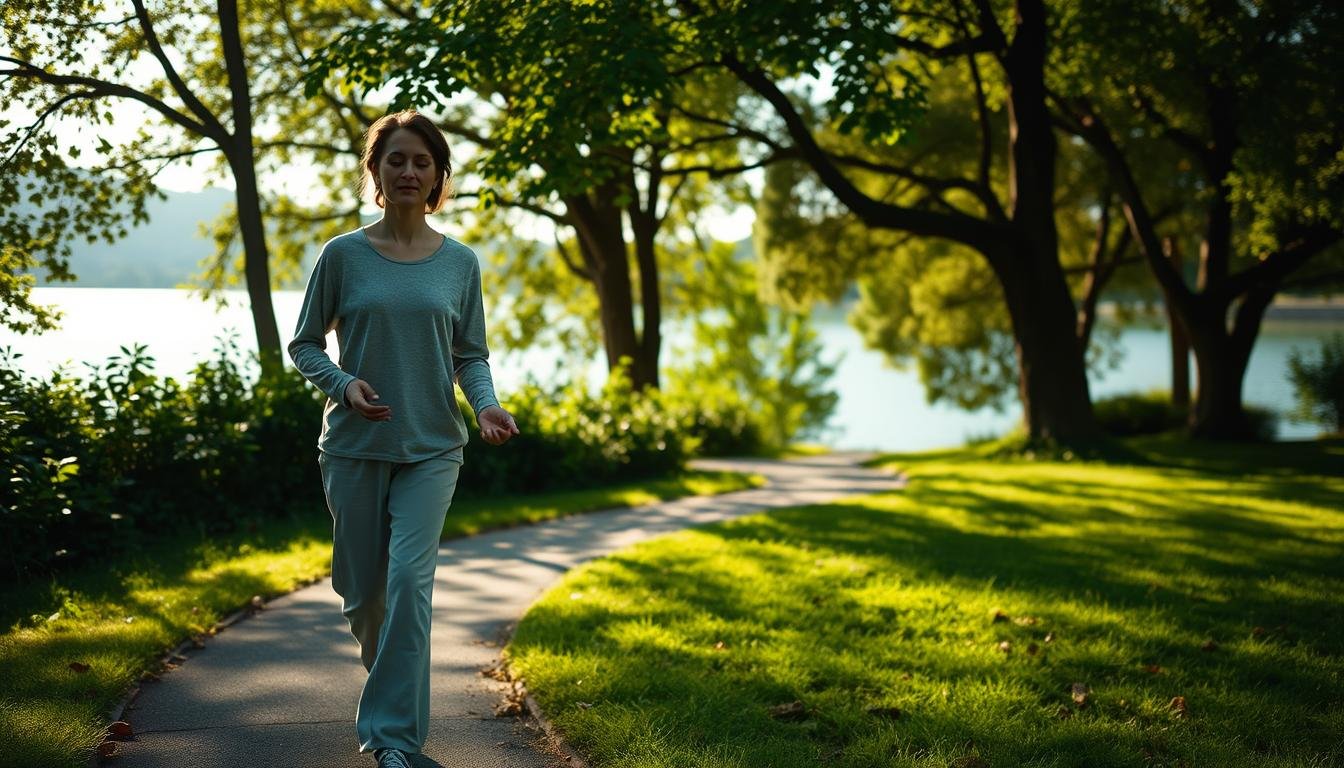
Begin by choosing a quiet path. Walk at a natural pace and let your hands rest comfortably at your sides. If your attention wanders, count your steps from one to ten, then start again at one. This technique helps keep your focus sharp.
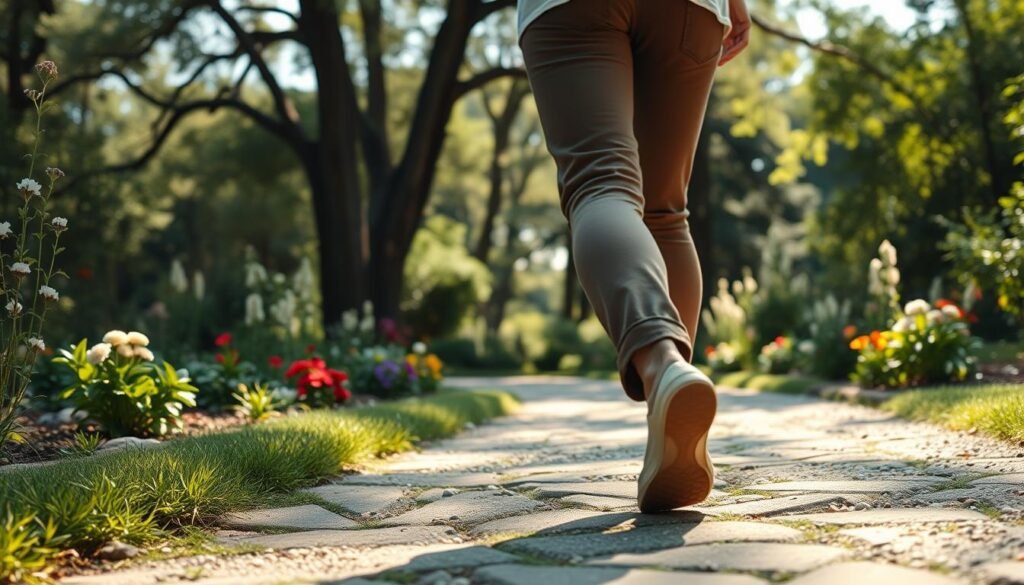
Notice the lifting and falling of your feet, the movement of your legs, and the gentle shifts of your body. As you walk, expand your awareness to include the sounds, smells, and sights around you. Avoid labeling these experiences; simply observe them.
To close your practice, stand still for a moment. Reflect on how you can carry this awareness into the rest of your day.
| Step | Action | Awareness Focus |
|---|---|---|
| 1 | Choose a quiet path | Body position |
| 2 | Walk naturally | Feet and legs |
| 3 | Count steps if distracted | Mindful attention |
| 4 | Expand awareness | Environment |
| 5 | Stand still to reflect | Present moment |
Key Benefits for Body and Mind
Consider how intentional movement can unlock benefits for both your mind and body. Engaging in walking meditation can enhance your focus and emotional balance. Research shows that this practice may help you strengthen your concentration. By repeatedly returning your attention to your feet, you create a mental anchor.
In a study by Gotink and colleagues in 2016, participants reported improved emotional regulation through mindful walking. Similarly, Yang and Conroy’s 2019 research highlighted how outdoor mindful walking can reduce negative feelings in older adults. These findings suggest that this practice can significantly impact your emotional well-being.
Moreover, a study by Bigliassi et al. in 2020 examined the psychological benefits of self-paced walking. It revealed that being mindful during movement can enhance your awareness of sensations and surroundings. However, it’s essential to remember that while walking meditation offers valuable support, it should complement professional care for persistent issues.
| Study | Year | Findings |
|---|---|---|
| Gotink et al. | 2016 | Improved emotional regulation |
| Yang & Conroy | 2019 | Reduced negative affect in older adults |
| Bigliassi et al. | 2020 | Enhanced awareness during self-paced walking |
| Prakhinkit et al. | 2014 | Buddhist walking meditation for depression |
| Jung et al. | 2015 | Mindfulness and diabetes management |
Preparing Your Space for Mindfulness
Consider how the space you choose for movement can impact your mindfulness experience. The right environment can enhance your practice, whether indoors or outdoors. Suitable locations include a hallway, a large room, or a peaceful park. Each offers unique benefits and can cater to different preferences.
When you’re indoors, opt for a clear, level path. This is especially important if you feel unsteady or easily distracted. Outdoor settings, like wooded trails or familiar city routes, provide a different experience. However, stay aware of your surroundings to avoid obstacles like traffic or uneven ground.
Even in challenging spaces, mindfulness can thrive. Sister Tri Hai practiced in a prison cell, taking seven steps before turning around. This illustrates that meaningful practice doesn’t require a beautiful setting.
Here are some spaces to consider:
| Setting | Benefits | Considerations |
|---|---|---|
| Hallway | Clear path, easy access | Limited space |
| Large Room | Freedom to move | May feel empty |
| Quiet Park | Natural environment | Weather-dependent |
| Wooded Trail | Calming nature | Uneven ground |
| City Streets | Familiar surroundings | Traffic awareness |
Integrating Walking Meditation Into Your Daily Routine
Consider how simple transitions in your day can become opportunities for mindfulness. Integrating walking meditation into your routine doesn’t have to be complicated. You can start by attaching a brief session to existing activities. For example, when you walk from your car to the office or between floors, take a moment to focus on your steps.
Start with just five minutes or choose a familiar route. Gradually increase the duration as you feel more comfortable. This way, you’re building a sustainable practice that fits your life. Scheduling sessions on your calendar can also help. You might use a doorway as a cue to remind you to check in with your breath.
In a study by Neto and colleagues in 2020, first-year medical students incorporated mindfulness into their busy schedules. This illustrates how even structured environments can benefit from mindfulness. After your session, reflect on how this awareness can carry into the rest of your day.
- Attach walking sessions to daily transitions.
- Start small and increase duration gradually.
- Schedule sessions and use cues to remind you.
- Reflect on your experience to enhance awareness.
Connecting Breath and Movement
Imagine how syncing your breath with each step can transform your experience of movement. This connection can enhance your mindfulness practice. One breath may accompany one step, or you might inhale over two or three steps while exhaling over three, four, or five steps. Remember, the goal is not to force your breathing but to let it flow naturally.
Uphill and downhill walking can change the number of steps taken per breath. It’s essential to listen to your body and adjust accordingly. You may find that a relaxed half-smile helps maintain calm and focus. This practice can last from 30 minutes to an hour, blending breath, steps, and awareness.
- Notice your natural breathing rhythm before coordinating it with your steps.
- For example, try inhaling for two or three steps and exhaling for three, four, or five steps.
- Be aware that hills, stairs, and your emotional state can affect your comfortable breathing pattern.
- Only adopt a half-smile if it feels natural; prioritize ease and present-moment awareness.
- Start practicing for a few minutes and gradually increase the time.
Walking Meditation as Self-Care
Consider how each step you take can serve as a small gift to yourself. Engaging in walking meditation allows you to reconnect your body and mind after a busy day filled with screens and stress. This practice can be a simple yet profound way to nurture your well-being.
Taking a mindful walk is a small act of care. It helps you pause, notice your body, and step out of the constant busyness of life. Early morning air or a quiet neighborhood can be perfect for these gentle transitions into your day.
Self-care doesn’t have to be complicated. It can be as simple as feeling the soles of your feet on the ground, breathing comfortably, and allowing your thoughts to settle naturally. Each step becomes a reminder of gratitude for the earth beneath you and the support it provides.
Incorporating this practice into your routine can enhance your awareness and appreciation for the world around you. For more tips on intentional living and creating a sustainable wellness routine, check out our related content on BetterLifeAtlas.
Guidelines for a Sustainable Practice
As you embark on your journey of mindful walking, you may encounter common hurdles along the way. It’s essential to address these challenges with compassion and practical solutions. Remember, it’s perfectly normal for your thoughts to wander. Each time this happens, gently return your focus to the sensations in your feet and the rhythm of your breath.
If you’re in a small space, consider pausing and turning around after taking seven or ten steps. This technique can help you maintain your practice without feeling confined. Sister Tri Hai, for example, turned around after just seven steps in her prison cell, showing that mindful movement can happen anywhere.
Always listen to your body. If you feel pain, dizziness, or fatigue, it’s okay to shorten your session or slow your pace. Sustainable practice means adapting to your environment, whether it’s dealing with noise, weather, or even the presence of others. Remember, awareness should enhance your safety, not distract you from it.

Real-Life Stories and Practical Examples
Every movement you make can become a chance to embrace mindfulness. Take Sister Tri Hai, for example. Despite being confined to a prison cell, she practiced mindful movement by taking seven steps before turning around. This simple act became a profound way for her to maintain her inner space and dignity.
Not only did she engage in her own practice, but she also shared her knowledge with fellow prisoners. She taught them how to sit and breathe, fostering connection and awareness among them. This illustrates that mindful practices can support both individual growth and community bonding.
Research backs up these experiences. In 2020, Gallegos and colleagues conducted a pilot study with survivors of intimate partner violence, showing the positive impact of mindfulness. Similarly, Gayner’s 2012 trial with gay men living with HIV highlighted how mindfulness can enhance well-being. Waldron and Burnett-Zeigler’s 2021 study focused on mindfulness interventions for Black women dealing with posttraumatic stress symptoms.
These stories remind us that walking meditation can adapt to various spaces, abilities, and cultural contexts. Think about how you can incorporate this practice into your life. Perhaps a mindful walk to the mailbox or a moment of awareness while waiting for the bus could be your starting point.
Conclusion
What if each moment of movement could become a gateway to mindfulness? Engaging in walking meditation starts with a natural pace and an awareness of your feet. When your mind wanders, gently guide it back to the sensations of each step.
Breath and movement connect your body and mind, enhancing your overall experience. The environment you choose—be it a hallway, city route, or even a small space—can support your practice.
Focus on one short daily walk, prioritizing consistency, comfort, and safety over duration or perfection. Today, take one mindful step and notice how it transforms your ordinary experience into something intentional.
FAQ
What is walking meditation?
Walking meditation is a practice that combines movement with mindfulness. It involves paying attention to each step and the sensations in your body as you walk, helping you stay present in the moment.
How is walking meditation different from traditional meditation?
Unlike traditional meditation, which often involves sitting still, this practice allows you to engage your body while focusing your mind. It brings awareness to your movements and surroundings, making it accessible to those who find sitting still challenging.
What are the benefits of practicing mindful walking?
Mindful walking can enhance focus, reduce stress, and improve emotional balance. It encourages you to connect with your body and environment, promoting a sense of calm and clarity.
How can I prepare my space for walking meditation?
Choose a peaceful setting, whether indoors or outdoors, free from distractions. Ensure you have enough space to walk comfortably, allowing you to focus on your practice.
How can I integrate walking meditation into my daily routine?
Start by setting aside a few minutes each day for this practice. You can incorporate it into your commute, take mindful walks during breaks, or dedicate specific times in your schedule for it.
How do I synchronize my breath with my steps?
Begin by finding a comfortable pace. As you walk, inhale for a few steps and exhale for the same number. This connection between breath and movement enhances your mindfulness experience.
What challenges might I face when starting walking meditation?
Common challenges include distractions from your environment or wandering thoughts. Acknowledge these moments and gently bring your focus back to your steps and breath.
Can you share any real-life examples of walking meditation?
Many practitioners report feeling more grounded and centered after incorporating mindful walking into their lives. Stories often highlight improved mental clarity and emotional resilience.